-
-
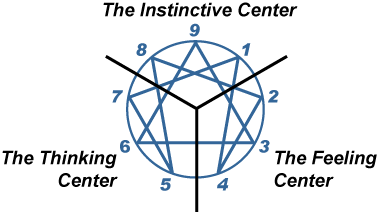
The inclusion of each type in its Center is not arbitrary. Each type results from a particular relationship with a cluster of issues that characterize that Center. Most simply, these issues revolve around a powerful, largely unconscious emotional response to the loss of contact with the core of the self. In the Instinctive Center, the emotion is Anger or Rage. I==n the Feeling Center, the emotion is Shame,== and in the Thinking Center, it is Fear ^3abOc7ma-
-
-
3 instincts one of which dominates
- survival vs. sexual vs. social
- im most likely social
-
Thus, Social types are highly aware of other people, whether they are in intimate situations or in groups. They are also aware of how their actions and attitudes are affecting those around them. Moreover, Sexual types seek intimacy, Social types seek personal connection: they want to stay in long-term contact with people and to be involved in their world. ^^Social types are the most concerned with doing things that will have some impact on their community, or even broader domains. They tend to be warmer, more open, engaging, and socially responsible than the other two types. ^^In their primary relationships, they seek partners with whom they can share social activities, wanting their intimates to get involved in projects and events with them. Paradoxically, they actually tend to avoid long periods of exclusive intimacy and quiet solitude, seeing both as potentially limiting. Social types lose their sense of identity and meaning when they are not involved with others in activities that transcend their individual interests.
-
_ first time was 3, 7, 2 _ now it’s 3, 4, (5, 9, 7) _ https://tests.enneagraminstitute.com/test-code/1025249/result _
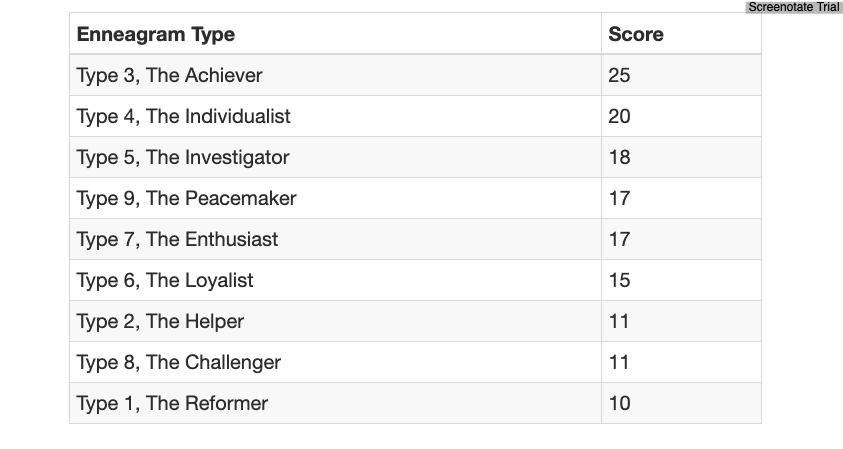 _ area for growth is to integrate and be comfortable trusting people
_ goals need to stop being suspicious and competitive, play infinite games
_ > As Threes let go of their fears of failure and worthlessness, they start to feel less competitive with others. They relax and find that they feel most valuable while working cooperatively with others toward shared goals and aspirations, like healthy Sixes. They learn to freely offer support and guidance to the people in their lives, but more importantly, they also learn to ask for support when they need it. Threes ordinarily put themselves under such pressure to accomplish their goals with little or no help that it comes as both a surprise and a relief to them that others are happy to help them in their endeavors. In short, Threes learn to trust others and to build lasting bonds with people. They become more selfless and courageous, embodying real qualities of leadership and self-sacrifice. By letting go of their need to outshine others, Threes become truly extraordinary human beings
_ my biggest area of growth is trusting people and becoming selfless in my interactions with them
_ fear and shame are my biggest emotions that indicate unhealthy disconnect from my core self
_ > The inclusion of each type in its Center is not arbitrary. Each type results from a particular relationship with a cluster of issues that characterize that Center. Most simply, these issues revolve around a powerful, largely unconscious emotional response to the loss of contact with the core of the self. In the Instinctive Center, the emotion is Anger or Rage. I==n the Feeling Center, the emotion is Shame,== and in the Thinking Center, it is Fear ^3abOc7ma-
_ area for growth is to integrate and be comfortable trusting people
_ goals need to stop being suspicious and competitive, play infinite games
_ > As Threes let go of their fears of failure and worthlessness, they start to feel less competitive with others. They relax and find that they feel most valuable while working cooperatively with others toward shared goals and aspirations, like healthy Sixes. They learn to freely offer support and guidance to the people in their lives, but more importantly, they also learn to ask for support when they need it. Threes ordinarily put themselves under such pressure to accomplish their goals with little or no help that it comes as both a surprise and a relief to them that others are happy to help them in their endeavors. In short, Threes learn to trust others and to build lasting bonds with people. They become more selfless and courageous, embodying real qualities of leadership and self-sacrifice. By letting go of their need to outshine others, Threes become truly extraordinary human beings
_ my biggest area of growth is trusting people and becoming selfless in my interactions with them
_ fear and shame are my biggest emotions that indicate unhealthy disconnect from my core self
_ > The inclusion of each type in its Center is not arbitrary. Each type results from a particular relationship with a cluster of issues that characterize that Center. Most simply, these issues revolve around a powerful, largely unconscious emotional response to the loss of contact with the core of the self. In the Instinctive Center, the emotion is Anger or Rage. I==n the Feeling Center, the emotion is Shame,== and in the Thinking Center, it is Fear ^3abOc7ma-