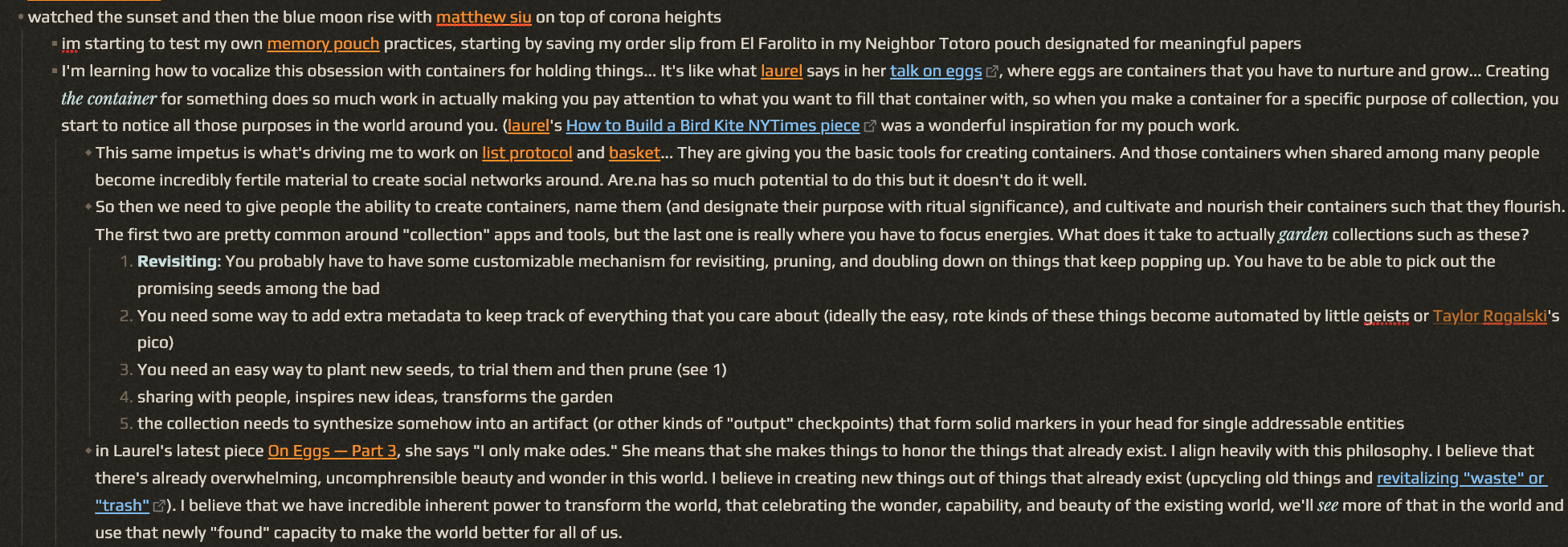
in conversation with matthew siu
2023-09-14
Thank you for the link to Michael’s piece! It was super cool to review his notes and a lot resonated. The parts where he focuses in on how much of an emotional problem it is especially sticks out. We know how to do the intellectual parts—that’s what we’re good at. People know intuitively what they need to do when they’re in the the right environment, so our job is just to allow people to inhabit those environments more.
I feel like instead of “mechanisms” I’m gravitating towards something more like ritual or practice for keeping a context alive. These contexts are living things and must be maintained to stay alive and cultivated to grow. A good creative context should like a whirlpool: it creates a gravitational force that pulls you back into the target focus and makes you feel like working on that problem or in that direction is the natural thing to do. I feel the most motivated when everything finally clicks and manifests in a concrete thread to pull on. A creative context should not have too many threads. Or at least the most important ones should feel immediately apparent.
So how do we keep contexts alive? How do we steward these creative environments?
My mind goes to people I admire who manage to perpetually be balancing an innumerable array of projects. And rather than being a downside, the variety and immense quantity of things they are responsible for at any given moment is what gives them the momentum to keep going. Virgil Abloh is a great example of this, with projects ranging across fashion, music, furniture, architecture, and more.
I recently finished this talk he gave about his creative process. The whole thing is fantastic, but one part stood out that made me think about this thread.
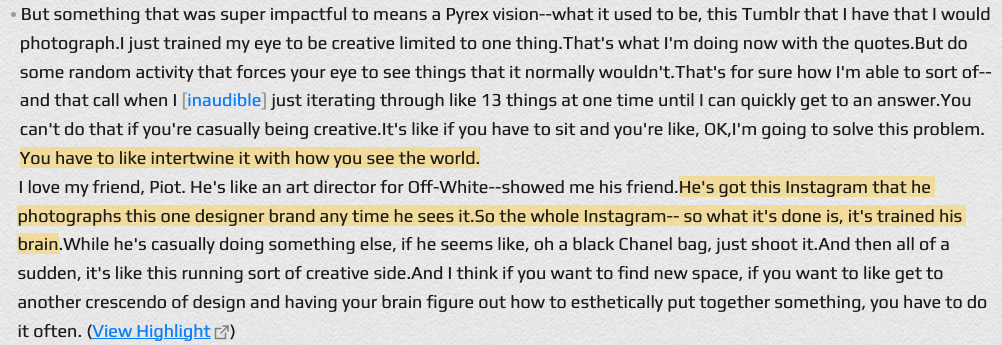
“You have to intertwine it with how you see the world.”
This example shows how critical it is for these contexts to be embedded into your daily living, and a lot of the time, inherently involves adding to a kind fo container (the instagram in this case).
You said that “the thing with containers today is that they feel like infinitely expanding containers,” but actually I don’t feel like this is the core problem. I think where we’ve seen this dynamics happen they feel overwhelming and wrong because they are constantly felt in very broad and generic containers (browsers, bookmarking apps, todo lists) that imply some pressure to triage. These contexts feel like the chair in the corner of your room that de-facto becomes the overflow storage for clothes that have been used a bit but should be reused before they get washed. They indicate the desire paths of our data consumption practices in a world where we are flooded by things that we think we should pay attention to. It’s far too easy to add to these things because the filter for whether something belongs is far too unclear, and then we feel like we have more work to do to get rid of them.
What does the practice of stewarding a container look like without these two conditions? When we have a specific condition (e.g. Chanel bags) and no pressure to triage, how does this context become interwoven into our natural way of living?
I’ve been experimenting with a few of these kinds of logs lately—my I love living shortcut, a “moments of clarity” log, and a log of all the plants I notice. I can feel my brain getting rewired every time I add to these logs, so the actual result of adding to the container doesn’t matter so much as the act of deciding to add to it. After you conduct this practice enough times, does the creative context become a natural part of you, and in that world what do you need to trigger yourself back into the context when you lose it but you know it’s inherent inside of yourself?
How else can you cultivate or steward these contexts? What other practices have you seen people take towards this end?
matt - 2023-09-01
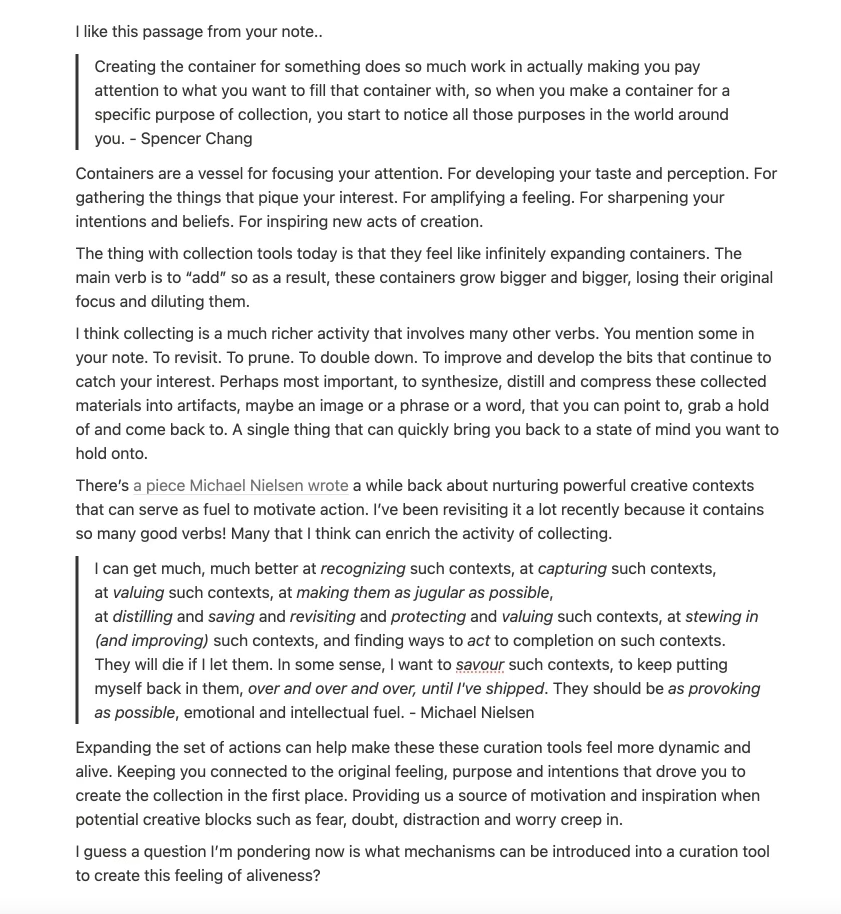
spencer - 2023-08-30