short book by Jenny Odell which is basically a retelling of her speech to the 2020 virtual commencement of the harvard graduate school of design
First, she brings up the concept of how the world enforces two things that are detrimental to meaningful work, that is creative and novel and future-looking:
- artificial urgency to constantly produce (activities that involve making) and optimize productivity, slowness is good
- pressure to follow “right” proven pathways rather than start from first principles
First, I want to come back to that word career. As a verb it means to move at full speed-”to career?.-and it’s etymologically related to the word car. And yet, in my experience, many people who feel fulfilled in what they do would not see their trajectory that way; certainly I would not. What I have done, and what I enjoy doing, feels closer to a walk that starts and stops—one with no destination, where I’d often get lost or waylaid by something interesting. Sometimes I went in circles or walked in a labyrinth or climbed to the top of a hill. Sometimes I walked backward, or with my eyes closed. And many times, I stopped walking. I “did nothing.”
She talks about the concept of orchestrating attention and the designer as an orchestrator of attention, and how in that light, a lot of the “design” that people do for extractive companies are not really good design at all in even the most narrow sense of the word productivity
There is a moment of realization of understanding nothing, which is a very humble act that forms the foundation of being able to see the world as it actually is, rather than putting your own or society’s preconceived notions upon it and seeing it through that artificial lens.
I believe that we individually have the ability to direct our attention-for example, to see in multiple time frames at once, or at the very least outside of the default temporality of everyday life. But I also believe that we need help doing this, and that’s why the role of the artist and designer that’s most important to me right now is indeed one as an orchestrator of attention, someone who can create the lenses with which we can see a completely different reality--not one that is imaginary or fabricated, but that has in fact been there all along. Of course, doing this requires close attention on the orchestrator’s part as well, which is what brings me to the second idea I mentioned, of design as response--not to the world as you want it to be or expect it to be, but a response to the world as it really is, right now, in all of the detail that unfolds if you just give yourself time to see it.
Brings up example of Masanobu Fukuoka.
understanding nothing is a “moment of exhilaration, and the underpinnings of the humility that eventually led to do-nothing farming. To understand nothing is to see everything—to have an empty enough mind to observe what is actually there.”
Being fully alive in every moment is crucial:
I found myself telling her to look for theaffordances of the moment. By that I meant to give herself time to actually observe this moment in all of its detail- in essence, to draw lines around the negative space, and in so doing, see the possibilities that would be otherwise obscured.
on starting from first principles:
you have to provide that opportunity for yourself. And trust that in any given moment, it is more possible than you think. You can even come to a point where you can create that opportunity for others. To see spaces differently is already to imagine different ways of moving through them. To see things differently is to imagine new uses for them.
disabled woman who got a fancy expensive robot arm but then created a bunch of home devices for herself because it wouldn’t let her do the basic things she wanted. Fantastic example of Situated Software
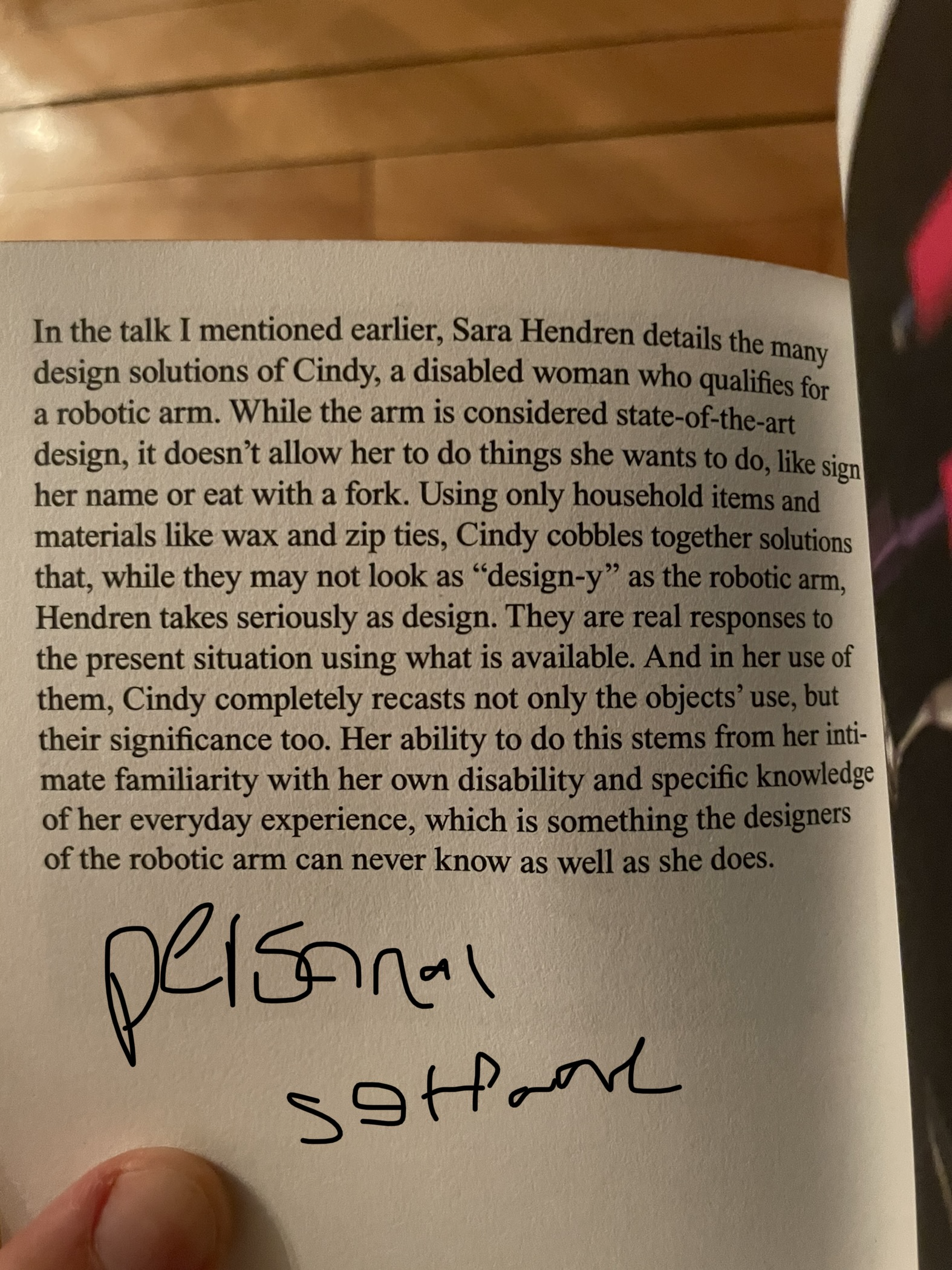
design as sensemaking
Excerpt from Thomas Merton about starting from the ugly reality we stand and then imagining better rather than from an ungrounded abstract world.
“If I had no choice about the age in which I was to live, I nevertheless have a choice about the attitude I take and about the way and the extent of my participation in its living ongoing events. To choose the world is … an acceptance of a task and a vocation in the world. in history, in time. In my time, which is the present.”