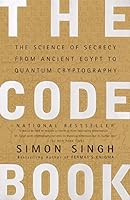
Author:: Simon Singh
Full Title:: The Code Book
Tags:#media/book
- themes::
- theme 1
- Summary::
- summary 1
* highlights from 2021-02-08
* It has been said that the First World War was the chemists’ war, because mustard gas and chlorine were employed for the first time, and that the Second World War was the physicists’ war, because the atom bomb was detonated. Similarly, it has been argued that the Third World War would be the mathematicians’ war, because mathematicians will have control over the next great weapon of war—information. ([Location 115](https://readwise.io/to_kindle?action=open&asin=B004IK8PLE&location=115))
* Secret communication achieved by hiding the existence of a message is known as steganography, derived from the Greek words steganos, meaning “covered,” and graphein, meaning “to write.” ([Location 221](https://readwise.io/to_kindle?action=open&asin=B004IK8PLE&location=221))
* The aim of cryptography is not to hide the existence of a message, but rather to hide its meaning, a process known as encryption. ([Location 237](https://readwise.io/to_kindle?action=open&asin=B004IK8PLE&location=237))
* cryptography itself can be divided into two branches, known as transposition and substitution. In transposition, the letters of the message are simply rearranged, effectively generating an anagram. ([Location 250](https://readwise.io/to_kindle?action=open&asin=B004IK8PLE&location=250))
* In transposition each letter retains its identity but changes its position, whereas in substitution each letter changes its identity but retains its position. ([Location 289](https://readwise.io/to_kindle?action=open&asin=B004IK8PLE&location=289))
* Each distinct cipher can be considered in terms of a general encrypting method, known as the algorithm, and a key, which specifies the exact details of a particular encryption. ([Location 314](https://readwise.io/to_kindle?action=open&asin=B004IK8PLE&location=314))
* “Kerckhoffs’ Principle: The security of a cryptosystem must not depend on keeping secret the crypto-algorithm. The security depends only on keeping secret the key.” ([Location 323](https://readwise.io/to_kindle?action=open&asin=B004IK8PLE&location=323))
* A nomenclator is a system of encryption that relies on a cipher alphabet, which is used to encrypt the majority of a message, and a limited list of codewords. ([Location 669](https://readwise.io/to_kindle?action=open&asin=B004IK8PLE&location=669))
* the cipher is known as the Vigenère cipher in honor of the man who ([Location 922](https://readwise.io/to_kindle?action=open&asin=B004IK8PLE&location=922))
* homophonic substitution cipher. Here, each letter is replaced with a variety of substitutes, ([Location 984](https://readwise.io/to_kindle?action=open&asin=B004IK8PLE&location=984))
* The security of the onetime pad cipher is wholly due to the randomness of the key. The key injects randomness into the ciphertext, and if the ciphertext is random then it has no patterns, no structure, nothing the cryptanalyst can latch onto. ([Location 1982](https://readwise.io/to_kindle?action=open&asin=B004IK8PLE&location=1982))
* If necessity is the mother of invention, then perhaps adversity is the mother of cryptanalysis. ([Location 2279](https://readwise.io/to_kindle?action=open&asin=B004IK8PLE&location=2279))
* The ethos of blitzkrieg was “speed of attack through speed of communications.” ([Location 2513](https://readwise.io/to_kindle?action=open&asin=B004IK8PLE&location=2513))
* phonetic characters, or phonograms. ([Location 3188](https://readwise.io/to_kindle?action=open&asin=B004IK8PLE&location=3188))
* semagrams—that these intricate characters represented whole ideas, and were nothing more than primitive picture writing. ([Location 3190](https://readwise.io/to_kindle?action=open&asin=B004IK8PLE&location=3190))
* rebus principle. In a rebus, still found in children’s puzzles, long words are broken into their phonetic components, which are then represented by semagrams. ([Location 3337](https://readwise.io/to_kindle?action=open&asin=B004IK8PLE&location=3337))
* For example, a computer could be programmed to mimic the action of a hundred scramblers, some spinning clockwise, some anticlockwise, some vanishing after every tenth letter, others rotating faster and faster as encryption progresses. Such a mechanical machine would be practically impossible to build, but its “virtual” computerized equivalent would deliver a highly secure cipher. ([Location 3744](https://readwise.io/to_kindle?action=open&asin=B004IK8PLE&location=3744))
* The only positive response to Diffie’s presentation was from Alan Konheim, one of IBM’s senior cryptographic experts, who mentioned that someone else had recently visited the laboratory and given a lecture that addressed the issue of key distribution. That speaker was Martin Hellman, a professor from Stanford University in California. That evening Diffie got in his car and began the 5,000 km journey to the West Coast to meet the only person who seemed to share his obsession. The alliance of Diffie and Hellman would become one of the most dynamic partnerships in cryptography. ([Location 3908](https://readwise.io/to_kindle?action=open&asin=B004IK8PLE&location=3908))
    * **Note**: Power of good collaboration and partnership
* Now picture the following scenario. As before, Alice wants to send an intensely personal message to Bob. Again, she puts her secret message in an iron box, padlocks it and sends it to Bob. When the box arrives, Bob adds his own padlock and sends the box back to Alice. When Alice receives the box, it is now secured by two padlocks. She removes her own padlock, leaving just Bob’s padlock to secure the box. Finally she sends the box back to Bob. And here is the crucial difference: Bob can now open the box because it is secured only with his own padlock, to which he alone has the key. ([Location 3960](https://readwise.io/to_kindle?action=open&asin=B004IK8PLE&location=3960))
    * **Note**: Classic chicken crossing river brain teaser
* They focused their attention on one-way functions. As the name suggests, a one-way function is easy to do but very difficult to undo. In other words, two-way functions are reversible, but one-way functions are not reversible. ([Location 3999](https://readwise.io/to_kindle?action=open&asin=B004IK8PLE&location=3999))
* He can still recall how the idea flashed into his mind, and then almost vanished: “I walked downstairs to get a Coke, and almost forgot about the idea. I remembered that I’d been thinking about something interesting, but couldn’t quite recall what it was. Then it came back in a real adrenaline rush of excitement. I was actually aware for the first time in my work on cryptography of having discovered something really valuable. Everything that I had discovered in the subject up to this point seemed to me to be mere technicalities.” ([Location 4119](https://readwise.io/to_kindle?action=open&asin=B004IK8PLE&location=4119))