Author:: John Palmer Link:: https://j.mirror.xyz/RUeJfZEZxr-hkuzUCakQyUuf2kOJVMPPiAWBaQFhhqc Tags:#media/article media narrative productive discourse Hyperpop Summary::
- notes::
- Hyperpop
-
A standout example from 2020 was the rise of “Hyperpop.” The term came about to describe a particular musical aesthetic associated with artists like A.G. Cook and SOPHIE, and gained momentum over the past couple years, reaching a peak sometime in early 2020.
- “a genre tag for distinctly genre-less music.”
- no one agrees on definition and the fight is over a binary categorization in terms of whether something is or is not hyperpop
-
- scissor label is based on slate star codex’s scissor statement
- scissor labels are categorical terms that happen to be maximally divisive.
- A scissor label is a word or phrase that, for the first time, establishes a widely embraced name for a trend without simultaneously establishing a canonical definition.
- everyone agrees on name of thing but people think it means different things
- lack of shared societal truth
- Once a scissor label is established, controlling its definition means controlling whatever the trend represents.
- popular narratives as an organizing force for online subcultures permanent
-
On tech Twitter, we see people peddling narratives like the future of communities, the creator economy, tools for thought, and the no-code “movement.” Oftentimes, these people are simply performing land grabs of their own, hoping to claim more and more territory within the narrative they deem powerful.
- on how use of term economy with different extensions frames the thing around making money
- capitalism frames everything under lens of making money Psychopolitics
- like what happened today to me with codaland and laura showing the candyland image
- on how use of term economy with different extensions frames the thing around making money
- controlling narrative is a grab for power permanent
- controlling the narrative is controlling the trend and the masses behind it
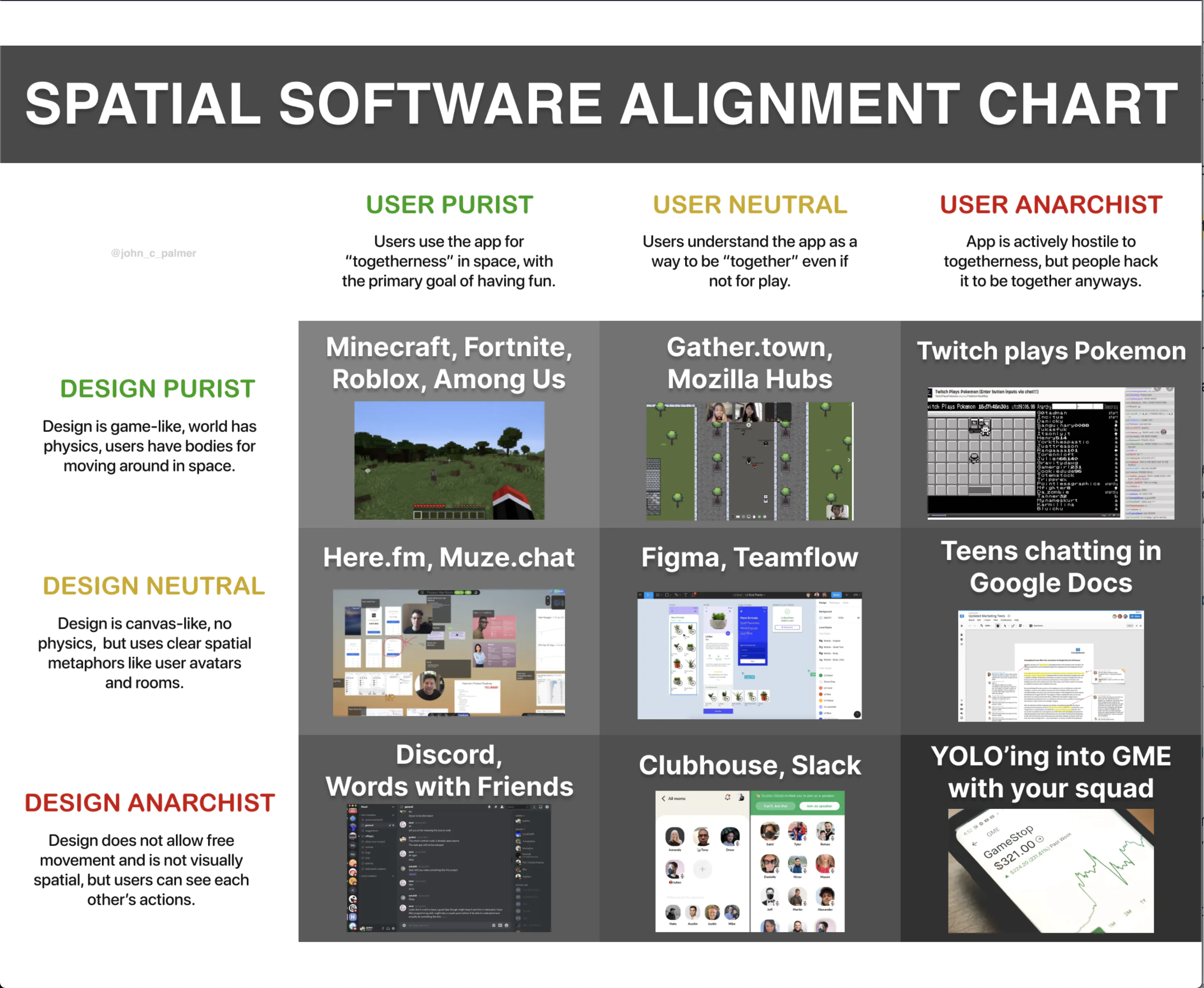
- spatial software term got hijacked by internet into diff terms, became a way to be legitimate and justify investment
- there’s a legitimacy associated with the branding that is developed
- definition isn’t purely technical, also purely cultural reasons that will be argued
- “When people argue over what is and isn’t Hyperpop, the conflict is not just about the definition of the word, but about preserving what it stands for. This kind of debate won’t end as long as there’s a community worth defending.”
- i.e. pewdiepie listening to it is not kosher / accepted by the OG hyperpop community
- “When people argue over what is and isn’t Hyperpop, the conflict is not just about the definition of the word, but about preserving what it stands for. This kind of debate won’t end as long as there’s a community worth defending.”
- how to counteract the normal unhealthy dynamics of discourse involving scissor labels?
- first step: identify what is really at stake, ignore the binary decision
- if definition is important, introduce spectrum or subcategories instead of binary decision, basically introduce [[nuance]
- “This shifts the conversation towards a much more curious place, focused on getting to know the rough topology and boundaries of the label instead of fighting over one definition. This isn’t just more accommodating, but often more accurate to the ideas a label describes.”
- Hyperpop