Qualities of Life

Metadata
Highlights
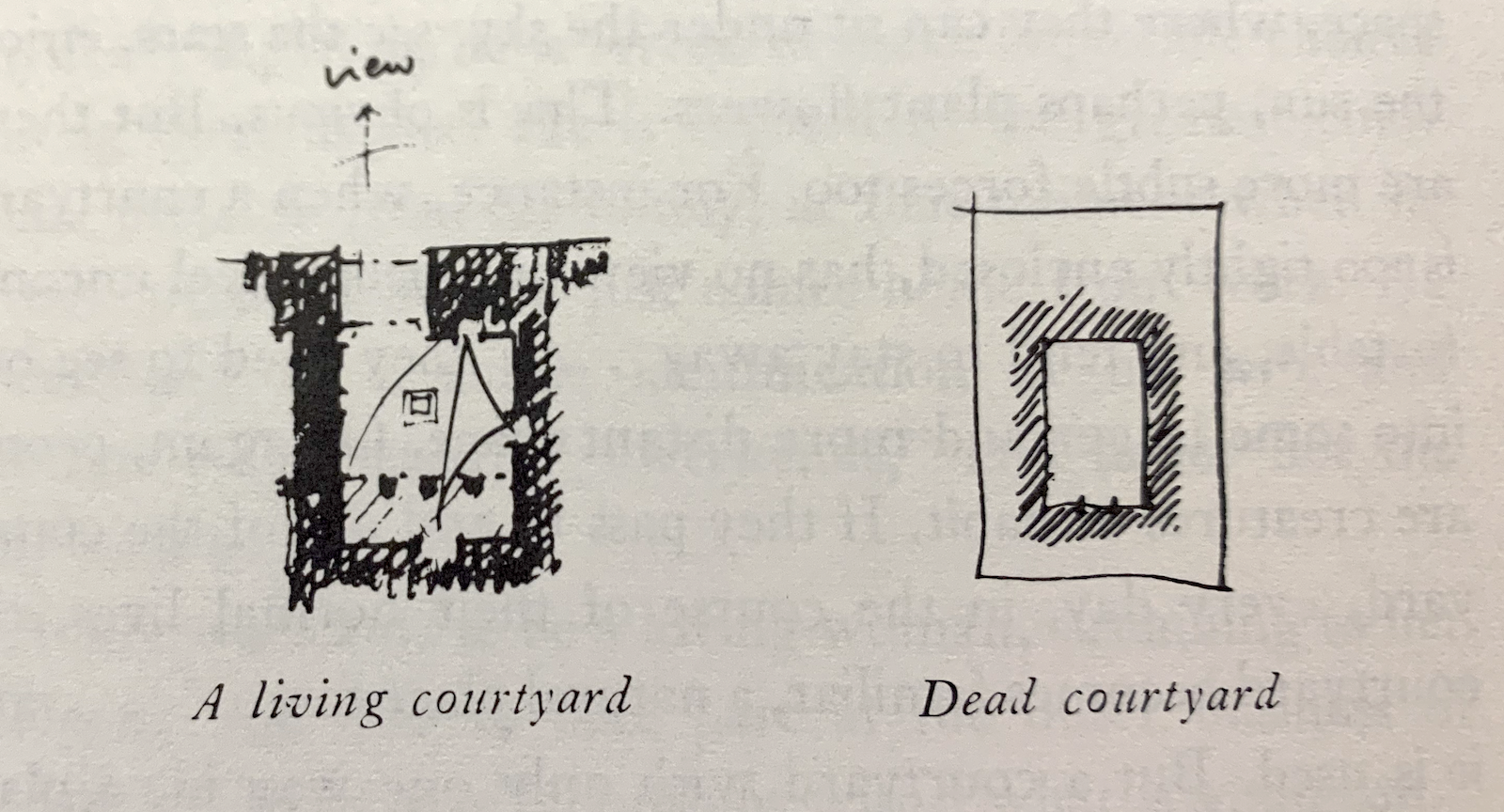
- Consider the difference between two places: The first is a courtyard ringed in verandas or porches that provide shelter from rain and bright sunlight—a half-outdoor experience; it also offers views onto a street or open square, and is criss-crossed by pathways between multiple entrances and exits. The second is a fully enclosed courtyard with a single way in and no views into other open spaces; it has an abrupt transition from inside to out, with no arcade or partial cover at the edges.
 (View Highlight)
- You may say—well, people can adapt. But in the process of adapting, they destroy some other part of themselves. We are very adaptive, it is true. But we can also adapt to such an extent that we do ourselves harm. The process of adaptation has its costs. It may be, for example, that the child adapts, by turning to books. The desire to play in the street conforms now to the dangers, and the mother’s cries. But now the person has lost some of the exuberant desire to run about. He has adapted, but he has made his own life less rich, less whole, by being forced to do so. (View Highlight)
- I’m always (as in literally every day) thinking about something journalist Tina Vasquez posted during our first covid summer: “What is the machine that did this to this person? (View Highlight)
- To be alive in the sense found in A Timeless Way of Building, a system would have to:
- avoid piling unresolveable stresses onto the people inside it,
- maintain its own aliveness through self-sustaining evolution and repair, and
- avoid worsening the life of the systems around it, ranging from peer-level technical systems to things like “civil society.”
This framework is so heartening to me because it torches the constructions of a system’s inhabitants’ well-being and the spillover of generated stresses into the wider world as externalities we need not consider. (View Highlight)
- In the same way, tech slogans like “We put users first,” could mean nearly anything, so they usually mean nothing. The first criteria for Alexanderian aliveness, though, translates into something like, “Create only features, interfaces, and systems that resolve conflicting human desires.” I think that’s something we could use. (View Highlight)
- • I want to have interesting conversations online without participating in modes of interaction I would never tolerate offline, ranging from brigading to individual abuse to soul-erodingly tedious explanation of my own words back to me.
• I want to be visible enough to make interesting friends and attract work that I’m good at without getting stalked, doxxed, or successfully targeted for mass harassment. Relatedly, I want people who are structurally least likely to be heard offline to be granted space and access without being made into sacrificial bait for hate campaigns.
• I want to be able to have semi-secluded conversations with variously durable and ephemeral sets of people without giving up my overall ability to participate in a wider, more public conversation. And I want to be able to be a good host, who can invite people into conversations without exposing them to the common brutalities. (View Highlight)
- I want to be able to browse through my online acquaintances’ varied interests like I was nosing through their bookshelves while they make coffee without sifting through stilted hashtags or stalking them across sites. I want to skip political slogans in favor of shared pathways into what we actually do in support of the ideas we care about. (View Highlight)
- On the purely selfish side, I want social tools to support my cognitive capacity during wide-ranging reading, not to weaken it. I want an easy way to find half-remembered fragments that doesn’t involve me carefully labeling everything I might someday wish to remember. I want a stereotypical little demon to coalesce, sift through what I told people I would email them or promised I’d check out, and send me a list—and then I want it to break down harmlessly into water and salt, retaining exactly nothing, selling out exactly no one. (View Highlight)
title: “Qualities of Life”
author: “Erin Kissane”
url: ”https://erinkissane.com/qualities-of-life”
date: 2023-12-19
source: reader
tags: media/articles
Qualities of Life
Metadata
Highlights
- Consider the difference between two places: The first is a courtyard ringed in verandas or porches that provide shelter from rain and bright sunlight—a half-outdoor experience; it also offers views onto a street or open square, and is criss-crossed by pathways between multiple entrances and exits. The second is a fully enclosed courtyard with a single way in and no views into other open spaces; it has an abrupt transition from inside to out, with no arcade or partial cover at the edges.
(View Highlight)
- You may say—well, people can adapt. But in the process of adapting, they destroy some other part of themselves. We are very adaptive, it is true. But we can also adapt to such an extent that we do ourselves harm. The process of adaptation has its costs. It may be, for example, that the child adapts, by turning to books. The desire to play in the street conforms now to the dangers, and the mother’s cries. But now the person has lost some of the exuberant desire to run about. He has adapted, but he has made his own life less rich, less whole, by being forced to do so. (View Highlight)
- I’m always (as in literally every day) thinking about something journalist Tina Vasquez posted during our first covid summer: “What is the machine that did this to this person? (View Highlight)
- To be alive in the sense found in A Timeless Way of Building, a system would have to:
- avoid piling unresolveable stresses onto the people inside it,
- maintain its own aliveness through self-sustaining evolution and repair, and
- avoid worsening the life of the systems around it, ranging from peer-level technical systems to things like “civil society.”
This framework is so heartening to me because it torches the constructions of a system’s inhabitants’ well-being and the spillover of generated stresses into the wider world as externalities we need not consider. (View Highlight)
- In the same way, tech slogans like “We put users first,” could mean nearly anything, so they usually mean nothing. The first criteria for Alexanderian aliveness, though, translates into something like, “Create only features, interfaces, and systems that resolve conflicting human desires.” I think that’s something we could use. (View Highlight)
- • I want to have interesting conversations online without participating in modes of interaction I would never tolerate offline, ranging from brigading to individual abuse to soul-erodingly tedious explanation of my own words back to me.
• I want to be visible enough to make interesting friends and attract work that I’m good at without getting stalked, doxxed, or successfully targeted for mass harassment. Relatedly, I want people who are structurally least likely to be heard offline to be granted space and access without being made into sacrificial bait for hate campaigns.
• I want to be able to have semi-secluded conversations with variously durable and ephemeral sets of people without giving up my overall ability to participate in a wider, more public conversation. And I want to be able to be a good host, who can invite people into conversations without exposing them to the common brutalities. (View Highlight)
- I want to be able to browse through my online acquaintances’ varied interests like I was nosing through their bookshelves while they make coffee without sifting through stilted hashtags or stalking them across sites. I want to skip political slogans in favor of shared pathways into what we actually do in support of the ideas we care about. (View Highlight)
- On the purely selfish side, I want social tools to support my cognitive capacity during wide-ranging reading, not to weaken it. I want an easy way to find half-remembered fragments that doesn’t involve me carefully labeling everything I might someday wish to remember. I want a stereotypical little demon to coalesce, sift through what I told people I would email them or promised I’d check out, and send me a list—and then I want it to break down harmlessly into water and salt, retaining exactly nothing, selling out exactly no one. (View Highlight)