On Elemental Computation
Metadata
Highlights
- By tracing the personal and earthly genealogy of computers and their predecessors, we can redefine and reconstitute their fundamental material properties based on discoveries made in the world around us — building hardware like earthenware. (View Highlight)
- Peters challenges the notion that media is limited to technological platforms and argues that environments themselves can act as media, influencing our experiences and shaping our interactions with the world. Within the book’s long, winding journey through the nature of water, fire, sky, earth, and ether media, he first recognizes our reliance on fire as a meta-medium holding the power to eviscerate and cultivate. “Electricity is the manifestation of vestal fire,” he writes; our digital computers rely on transistors, electrical switches that were once a centimeter long and are now only slightly larger than 14 times the width of a DNA molecule. At the heart of the digital realm lies binary logic — 0/1, on/off, true/false — providing a standardized and convergent approach to information processing. (View Highlight)
- Elemental Computation, in contrast, embraces the latent interconnections between computation and the continuous observation of elemental patterns and material conditions, unraveling an intricate web of relationships. (View Highlight)
- COVID test is an example of a simple fluid logic gate — positive or negative — simple in outcome, but demonstrating the utilization of elemental logic structures in everyday life (the test processes a biological sample (input) to determine the presence of the virus (output) using specific molecular reactions). The result is still not without failure due to false negatives and the dynamacy of biological materials and fluid — an illusion of a binary is reliant on tight feedback loops and often the creation of stasis, one of the many human phantasms. (View Highlight)
- The slime mold, without a brain or limbs, questions the nature of technology and intelligence. Its ability to solve complex problems without a centralized brain system suggests a form of intelligence not of the machine or human but rather the binding element of emergence.
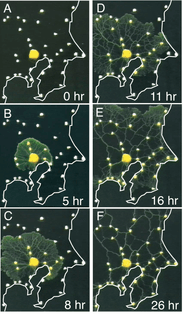 Toshiyuki Nakagaki, Tokyo rail network …
(View Highlight)
Toshiyuki Nakagaki, Tokyo rail network …
(View Highlight)
- A software runs on a physical computer that simulates a video game world allowing the construction of turing complete computers — a snake eating its tail, an ouroboros. (View Highlight)
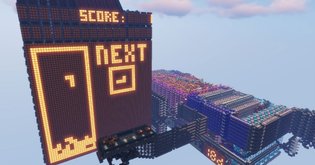 An Ouroboros (View Highlight)
- The significance of logic gates in Tears of the Kingdom is not their functionality, but rather how they relate to the game’s lore, narrative, and mythology. For those who are willing, this recontextualization of computational knowledge can now be discovered or applied to our experience of the world in itself. How we define a computer can become a retelling and one of mythological rediscovery as evident in the experience of this procedural rhetoric. Storytelling becomes a profound vehicle for meaning, allowing individuals to make sense of, relate to, and resonate with a redefining of our reality as well as expand and shape the narrative dynamically, adapting to its unfolding complexity. A story of Elemental Computation is made not of a single perspective but instead a kaleidoscope of the individual, community, and environment, to piece together and cultivate the natural beauty of the algorithmic into a future we wish to inhabit. (View Highlight)
title: “On Elemental Computation”
author: “are.na”
url: ”https://www.are.na/blog/on-elemental-computation”
date: 2023-12-19
source: reader
tags: media/articles
On Elemental Computation
Metadata
Highlights
- By tracing the personal and earthly genealogy of computers and their predecessors, we can redefine and reconstitute their fundamental material properties based on discoveries made in the world around us — building hardware like earthenware. (View Highlight)
- Peters challenges the notion that media is limited to technological platforms and argues that environments themselves can act as media, influencing our experiences and shaping our interactions with the world. Within the book’s long, winding journey through the nature of water, fire, sky, earth, and ether media, he first recognizes our reliance on fire as a meta-medium holding the power to eviscerate and cultivate. “Electricity is the manifestation of vestal fire,” he writes; our digital computers rely on transistors, electrical switches that were once a centimeter long and are now only slightly larger than 14 times the width of a DNA molecule. At the heart of the digital realm lies binary logic — 0/1, on/off, true/false — providing a standardized and convergent approach to information processing. (View Highlight)
- Elemental Computation, in contrast, embraces the latent interconnections between computation and the continuous observation of elemental patterns and material conditions, unraveling an intricate web of relationships. (View Highlight)
- COVID test is an example of a simple fluid logic gate — positive or negative — simple in outcome, but demonstrating the utilization of elemental logic structures in everyday life (the test processes a biological sample (input) to determine the presence of the virus (output) using specific molecular reactions). The result is still not without failure due to false negatives and the dynamacy of biological materials and fluid — an illusion of a binary is reliant on tight feedback loops and often the creation of stasis, one of the many human phantasms. (View Highlight)
- The slime mold, without a brain or limbs, questions the nature of technology and intelligence. Its ability to solve complex problems without a centralized brain system suggests a form of intelligence not of the machine or human but rather the binding element of emergence.
Toshiyuki Nakagaki, Tokyo rail network …
(View Highlight)
- A software runs on a physical computer that simulates a video game world allowing the construction of turing complete computers — a snake eating its tail, an ouroboros. (View Highlight)
-
An Ouroboros (View Highlight)
- The significance of logic gates in Tears of the Kingdom is not their functionality, but rather how they relate to the game’s lore, narrative, and mythology. For those who are willing, this recontextualization of computational knowledge can now be discovered or applied to our experience of the world in itself. How we define a computer can become a retelling and one of mythological rediscovery as evident in the experience of this procedural rhetoric. Storytelling becomes a profound vehicle for meaning, allowing individuals to make sense of, relate to, and resonate with a redefining of our reality as well as expand and shape the narrative dynamically, adapting to its unfolding complexity. A story of Elemental Computation is made not of a single perspective but instead a kaleidoscope of the individual, community, and environment, to piece together and cultivate the natural beauty of the algorithmic into a future we wish to inhabit. (View Highlight)