Kind Games: Designing for Prosocial Multiplayer
Metadata
Highlights
- Let’s make kind games where players help one another in safe, supportive environments. We define kind games as multiplayer games designed from the start with systems that deliberately promote prosocial behavior. (View Highlight)
- Toxicity in digital social systems can have real world consequences. Killing an NPC might have no impact on the real world, but social toxicity does transfer to real people. Facebook designers sought to quickly connect people via “soft tie” interactions to maximize simple engagement metrics – they didn’t intend to facilitate genocide, but then Myanmar happened. And then Ethiopia. From doxxing, brigading and swatting, to fostering hate groups, to increased isolation, depression and anxiety, systems that throw millions of strangers together without context or the opportunity to develop nuanced relationships have done real and lasting harm. (View Highlight)
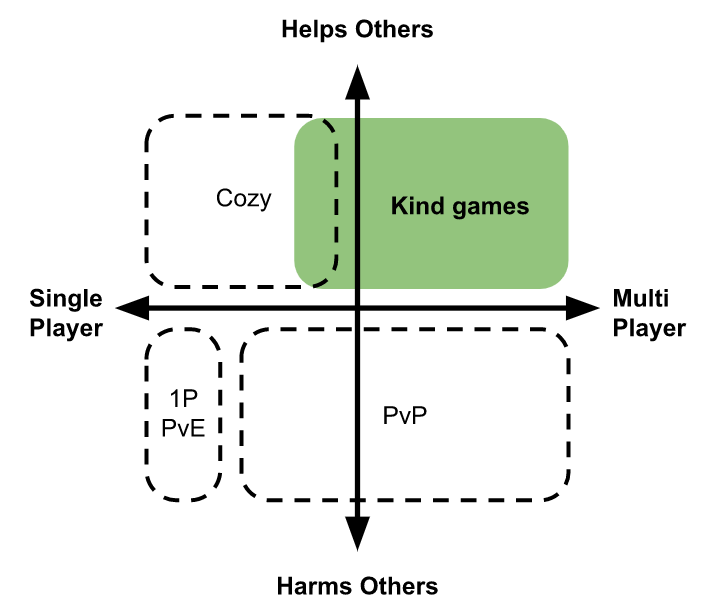
- Kind games are multiplayer games intentionally designed to emphasize prosocial behavior (players helping one another). Kind games in our definition have the following attributes:
• Systems encourage players to help one another and their community.
• Players form authentic attachments that alleviate loneliness.
• Groups interact peacefully with each other.
• Toxic behavior is carefully monitored and mediated.
• Social systems foster belonging. (View Highlight)
- • Safety: Players feel they can share and contribute without fear. They can opt into additional intimacy if they desire.
• Interdependence: Interdependent players coordinate with one another and work together to achieve more than an individual can accomplish alone. Cooperative systems provide underlying incentives for players to be kind. Like many of the values we discuss, there’s a sweet spot. Depending on the exclusivity of each player’s role and the skill level required, interdependence can be a double-edged sword. (View Highlight)
- • Kind games are distinctly multiplayer, not single player. Kindness is by definition a relational property: you are kind to someone. Consequently, you need to be playing with other people to build authentic human bonds and perform kindness. (Maybe you could be kind to real animals or plants, but as yet they don’t play video games.)
• Kind games focus on cooperative or interdependent play. They generally shy away from competitive play. (View Highlight)
Kind Games: Designing for Prosocial Multiplayer
Metadata
Highlights
- Let’s make kind games where players help one another in safe, supportive environments. We define kind games as multiplayer games designed from the start with systems that deliberately promote prosocial behavior. (View Highlight)
- Toxicity in digital social systems can have real world consequences. Killing an NPC might have no impact on the real world, but social toxicity does transfer to real people. Facebook designers sought to quickly connect people via “soft tie” interactions to maximize simple engagement metrics – they didn’t intend to facilitate genocide, but then Myanmar happened. And then Ethiopia. From doxxing, brigading and swatting, to fostering hate groups, to increased isolation, depression and anxiety, systems that throw millions of strangers together without context or the opportunity to develop nuanced relationships have done real and lasting harm. (View Highlight)
- Kind games are multiplayer games intentionally designed to emphasize prosocial behavior (players helping one another). Kind games in our definition have the following attributes:
• Systems encourage players to help one another and their community.
• Players form authentic attachments that alleviate loneliness.
• Groups interact peacefully with each other.
• Toxic behavior is carefully monitored and mediated.
• Social systems foster belonging. (View Highlight)
- • Safety: Players feel they can share and contribute without fear. They can opt into additional intimacy if they desire.
• Interdependence: Interdependent players coordinate with one another and work together to achieve more than an individual can accomplish alone. Cooperative systems provide underlying incentives for players to be kind. Like many of the values we discuss, there’s a sweet spot. Depending on the exclusivity of each player’s role and the skill level required, interdependence can be a double-edged sword. (View Highlight)
- • Kind games are distinctly multiplayer, not single player. Kindness is by definition a relational property: you are kind to someone. Consequently, you need to be playing with other people to build authentic human bonds and perform kindness. (Maybe you could be kind to real animals or plants, but as yet they don’t play video games.)
• Kind games focus on cooperative or interdependent play. They generally shy away from competitive play. (View Highlight)