Artist Sarah Sze: ‘We’ve Created a System That Can Destroy Us. That’s New’
Metadata
Highlights
- We’re talking on video, and as she peers through her screen I have the disconcerting sensation that it’s not just me she’s seeing. It turns out I’m right. She’s just as interested in the clutter around me, “like that coffee cup on your table, the plant, things that are not usually supposed to be seen”. She’s also alert to ambient sound and even smells, and their absence from digital encounters. “It would be interesting to be able to smell your perfume,” she says suddenly. “It would change the way I know you.” (View Highlight)
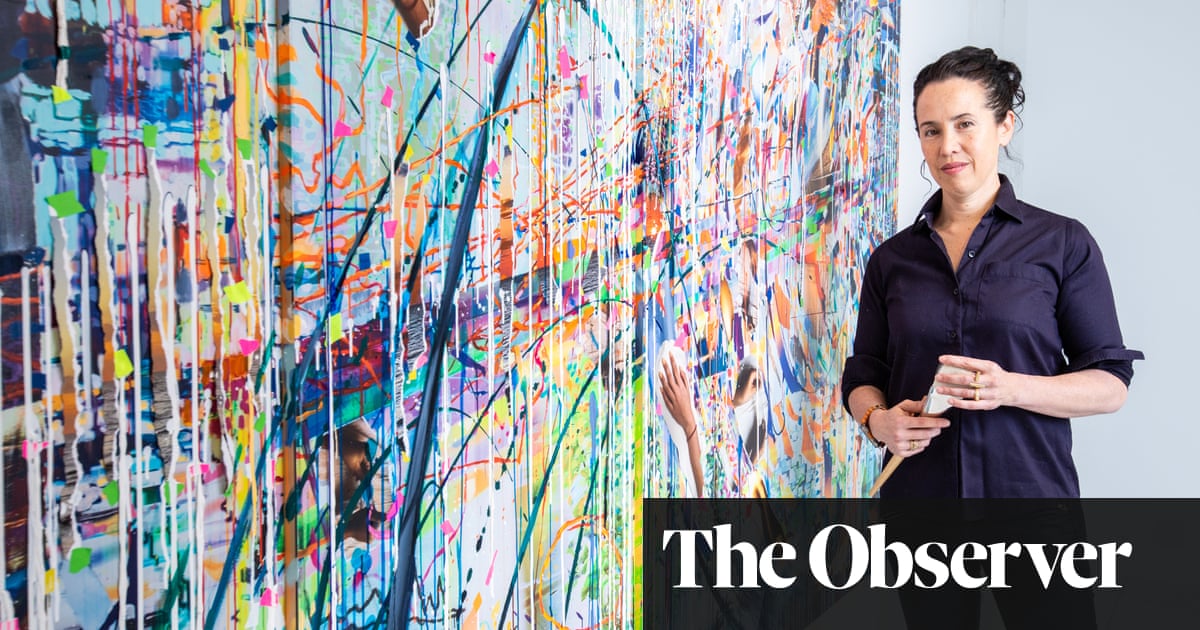
- She continued to make paintings but she didn’t show them. In recent years, she has incorporated them into her work. “They are very much about how we collect and organise images in our mind, through imagination or memory,” she says, “as opposed to how we experience images externally, with the continuous bombardment of visual information. The paintings come out of the sculptures, and my sculptures helped to inform what I wanted to do with painting.” (View Highlight)
- Note: the two different angles in a similar craft space influencing each other is how i want my art to influence my tools / my tools to influence my art
- She assembles her installations herself in real time, and will have less than a fortnight in London to bring The Waiting Room together. “It’s about bringing the life of the studio into the place, so you can glean the presence of it being made on site,” she says. “And for the viewer, that’s interesting, because you know that it was an experiment in real time in real space. It’s like a performance, but without the actor.” (View Highlight)
- In her work, she is constantly collecting and buying images, she adds. “If I want a volcano, I’m going to buy a volcano, and I can use it in my work the same way that I can buy and use a hammer.” (An erupting volcano is the promotional image for the show.) (View Highlight)
- In her other life, as professor of visual arts at Columbia University, she urged her students to do likewise, no matter how hard it was, because “it was a really important time for the expression of what it was to be a human, or is still to be human, to be put into artistic form”. (View Highlight)
Artist Sarah Sze: ‘We’ve Created a System That Can Destroy Us. That’s New’
Metadata
Highlights
- We’re talking on video, and as she peers through her screen I have the disconcerting sensation that it’s not just me she’s seeing. It turns out I’m right. She’s just as interested in the clutter around me, “like that coffee cup on your table, the plant, things that are not usually supposed to be seen”. She’s also alert to ambient sound and even smells, and their absence from digital encounters. “It would be interesting to be able to smell your perfume,” she says suddenly. “It would change the way I know you.” (View Highlight)
- She continued to make paintings but she didn’t show them. In recent years, she has incorporated them into her work. “They are very much about how we collect and organise images in our mind, through imagination or memory,” she says, “as opposed to how we experience images externally, with the continuous bombardment of visual information. The paintings come out of the sculptures, and my sculptures helped to inform what I wanted to do with painting.” (View Highlight)
- Note: the two different angles in a similar craft space influencing each other is how i want my art to influence my tools / my tools to influence my art
- She assembles her installations herself in real time, and will have less than a fortnight in London to bring The Waiting Room together. “It’s about bringing the life of the studio into the place, so you can glean the presence of it being made on site,” she says. “And for the viewer, that’s interesting, because you know that it was an experiment in real time in real space. It’s like a performance, but without the actor.” (View Highlight)
- In her work, she is constantly collecting and buying images, she adds. “If I want a volcano, I’m going to buy a volcano, and I can use it in my work the same way that I can buy and use a hammer.” (An erupting volcano is the promotional image for the show.) (View Highlight)
- In her other life, as professor of visual arts at Columbia University, she urged her students to do likewise, no matter how hard it was, because “it was a really important time for the expression of what it was to be a human, or is still to be human, to be put into artistic form”. (View Highlight)